
Sciatica & Lower Back pain in London & Reading | Yin-Yang Chinese Medicine
Shooting pain down one leg. A dull ache that won't leave your lower back. Numbness that wakes you at 3am. The cause is almost certainly mechanical — and treatable. At Yin-Yang Chinese Medicine, our Hong Kong-registered practitioners combine acupuncture and Tui Na bone-setting to address the structural root of your pain, not just the symptoms. We are part of a comprehensive approach to pain and urban health conditions serving patients across Wimbledon and Reading.
What Is Sciatica? The Anatomy Behind the Pain
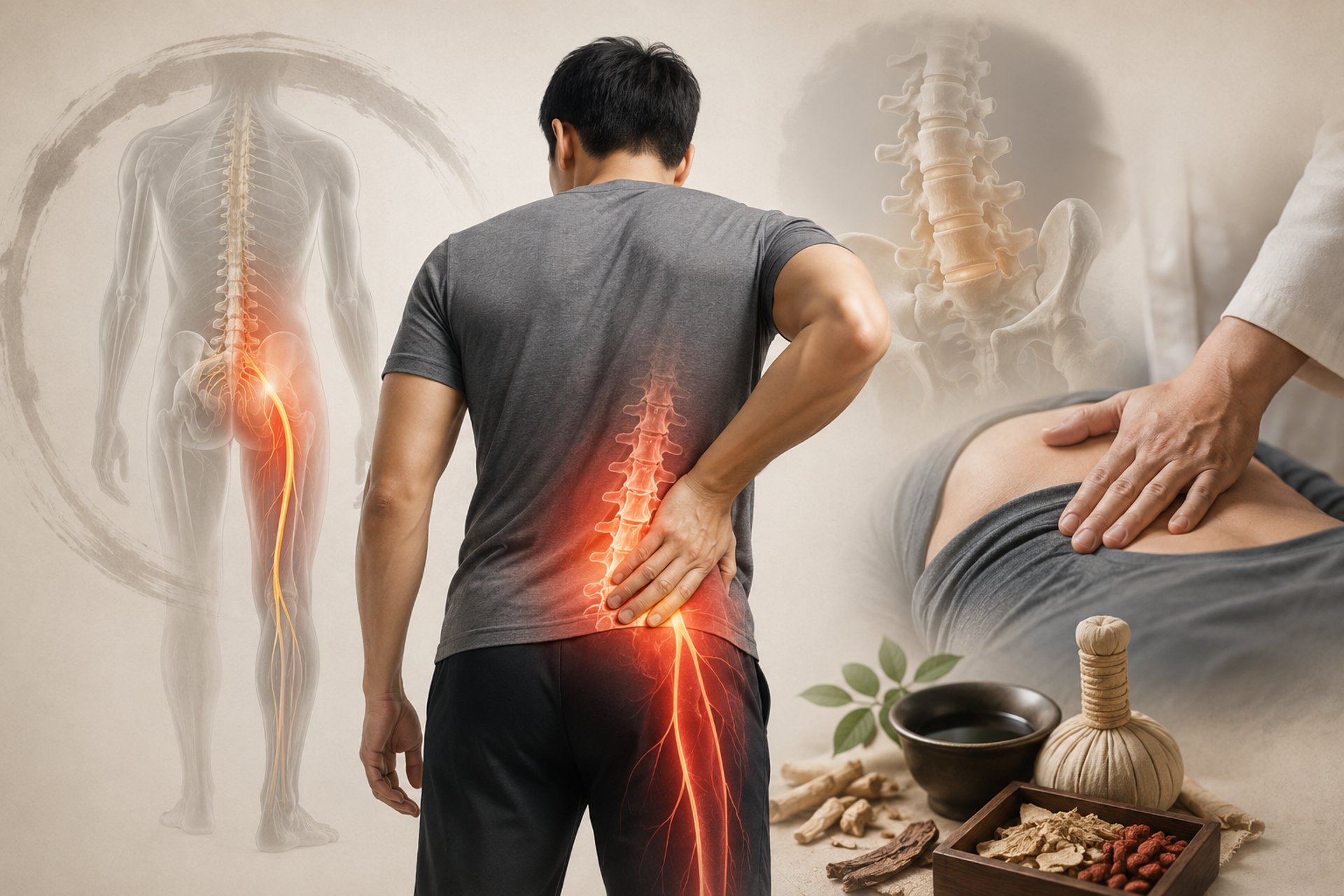
Sciatica is not a diagnosis — it is a symptom. Specifically, it describes irritation or compression of the sciatic nerve, the longest nerve in the human body, running from the lumbar spine through the gluteal region and down each leg to the foot.
Most patients describe a sharp, electric, or burning sensation travelling from the lower back into the buttock, thigh, or calf — typically on one side only.
How Sciatic Nerve Compression Happens
The sciatic nerve exits the spinal cord through openings between the lumbar vertebrae (L4–S3). When surrounding structures shift, swell, or degenerate, they encroach on this space. The nerve root responds with inflammation, generating pain signals along its entire length — which is why a problem in your spine can produce symptoms in your foot.
Key anatomical triggers include:
Intervertebral disc herniation: The soft inner nucleus of a spinal disc pushes through its outer wall, pressing directly against the nerve root.
Lumbar spinal stenosis: Gradual narrowing of the spinal canal reduces the space available for nerve tissue — common in adults over 50.
Facet joint degeneration: Worn cartilage in the small joints of the lumbar spine creates instability and localised inflammation.
Common Causes: Disc Herniation, Piriformis Syndrome & Spinal Degeneration
Piriformis syndrome is frequently misdiagnosed as disc-related sciatica. The distinction matters because the treatment approach differs significantly — a point where TCM's whole-body functional assessment has a clear clinical advantage.
How TCM Diagnoses Back Pain & Sciatica
Western imaging tells you where the structural problem is. TCM clinical assessment tells you why the structure failed — and what functional patterns are keeping it there.
Our Credentials
Combining Classical Assessment with Modern Functional Evaluation
At Yin-Yang Chinese Medicine, our practitioners hold Master of TCM degrees and trained within Hong Kong's hospital clinical system. Diagnosis integrates:
Orthopaedic testing: Straight Leg Raise (SLR), FABER, and lumbar range-of-motion assessment to localise nerve involvement.
Palpation mapping: Identifying myofascial trigger points, paraspinal muscle hypertonicity, and sacroiliac joint mobility.
TCM pattern differentiation: Assessing systemic contributors — constitution, sleep quality, stress load — that affect tissue recovery capacity.
This dual-layer assessment produces a treatment plan that addresses both the structural lesion and the physiological environment around it.
How TCM Complements — Not Replaces — Western Diagnosis
We do not ask patients to choose between TCM and their GP or physiotherapist. If you have an existing MRI or X-ray report, bring it. Our practitioners are trained to read imaging and integrate those findings directly into your treatment planning. Patients who have already received a formal Western diagnosis often find that TCM accelerates functional recovery where passive management alone has plateaued.
Our Core Treatment Protocols at Yin-Yang Chinese Medicine
Acupuncture: Targeted Nerve Modulation & Pain Relief
Acupuncture for pain management works through two clinically documented mechanisms in sciatica cases:
1. Local tissue effect: Fine needles inserted at paraspinal and gluteal points reduce localised inflammation, relax hypertonic muscle groups, and improve microcirculation to compressed nerve tissue.
2. Central nervous system modulation: Acupuncture stimulates the release of endogenous opioids and serotonin, raising the pain threshold and interrupting the chronic pain signalling loop that keeps the nervous system sensitised long after the original injury.
For sciatica, commonly used point clusters include the Bladder meridian (BL23, BL25, BL40), Gallbladder meridian (GB30, GB34), and local Ashi points mapped to the patient's specific pain distribution. Electroacupuncture may be applied at low frequency (2–4Hz) to enhance the analgesic effect in acute presentations.
Tui Na & Bone-Setting: Structural Realignment & Fascial Release
Where acupuncture addresses the neurological dimension, Tui Na and bone-setting addresses the mechanical one. Our practitioners apply:
Lumbar traction and rotational mobilisation to decompress intervertebral disc spaces and restore segmental mobility.
Piriformis and gluteal deep tissue release to directly address muscle-entrapment causes of sciatic irritation.
Sacroiliac joint manipulation where pelvic instability is identified as a contributing driver.
This is not generic massage. The bone-setting techniques used at Yin-Yang Chinese Medicine derive from orthopaedic Tui Na protocols refined in Hong Kong's clinical setting — precise, anatomy-informed, and adapted to each patient's presentation.
Three-Stage Treatment Pathway: Acute to Full Recovery
Stage 1
Stage 2
Stage 3
Pain Control
Structural Correction
Functional Rehabilitation
Weeks 1–3
Weeks 3-8
Weeks 8-12
Reduce nerve irritation and restore basic mobility. Primary modality: acupuncture with electrostimulation.
Address the mechanical root cause and restore joint alignment. Primary modality: Tui Na bone-setting with targeted acupuncture.
Rebuild movement patterns and prevent recurrence. Reduced treatment frequency plus self-management guidance.
Most patients with acute sciatica report measurable pain reduction within the first three sessions. Chronic cases — those with symptoms lasting over three months — typically require the full twelve-week pathway for stable, lasting results.
Hong Kong Clinical Standards, Delivered in the UK
Practitioner Credentials
Every practitioner at Yin-Yang Chinese Medicine holds dual qualifications — registration with the Hong Kong Chinese Medicine Practitioners Board and a postgraduate Master of TCM degree. This is the same credential standard required to practise within Hong Kong's public hospital system.
The clinical protocols, assessment standards, and treatment quality are consistent with what you would expect from a specialist TCM clinic in Hong Kong. For patients who moved from Hong Kong, and those who simply expect rigorous clinical training from their practitioner, this is a structural commitment — not a marketing claim.
Patients dealing with sports-related back and lower limb injuries will find the same standard of musculoskeletal care applied consistently across all presentations.
Clinic Locations: Wimbledon & Reading
London
Wimbledon (SW19)
Serving South West London including Merton, Raynes Park, and Sutton. Cantonese & English consultations available.
Berkshire
Reading (Castle Street)
Serving Berkshire and the Thames Valley including Henley, Wokingham, and Newbury. Same-week appointments available.
Frequently Asked Questions
How many sessions will I need for sciatica?
Acute presentations (under 6 weeks) typically respond within 4–6 sessions. Chronic sciatica with disc involvement usually requires 8–12 sessions across a structured pathway. Your practitioner will give a specific estimate after the first assessment.
Is acupuncture for sciatica evidence-based?
Yes. Multiple systematic reviews — including those published in The Spine Journal and endorsed by NICE guidelines for chronic primary pain — support acupuncture as an effective intervention for lumbar radiculopathy. We are happy to share specific references on request.
Can I continue seeing my GP or physiotherapist at the same time?
Absolutely — and we encourage it. TCM works best as part of an integrated care approach. Bring any existing imaging or physiotherapy notes to your first appointment.
Do you treat sciatica caused by disc herniation specifically?
Yes. Disc-related sciatica is one of the most common presentations we see. Our treatment approach differs from piriformis-related cases — the distinction is identified during the initial assessment.
Are consultations available in Cantonese?
Yes. All practitioners at Yin-Yang Chinese Medicine are fluent in Cantonese and English. For patients from Hong Kong, consultations can be conducted entirely in Cantonese if preferred.
What should I bring to my first appointment?
Any relevant imaging (MRI, X-ray), a list of current medications, and comfortable clothing that allows access to the lower back and legs.
Contact
Ready to book?
+44 07301 949 686
© 2025. Yin Yang CMC All rights reserved.
Phone
Reach us anytime — we usually respond within the hour.